India's Development Story Needs More Women Shaping It
Women On Boards is a three-month experiential program for accomplished women leaders seeking to contribute to social purpose organisations. It prepares participants to apply their expertise to board leadership and institutional decision-making.

Strengthening Governance Through Representation
Governance is strongest when it reflects the people and communities organisations serve. While global frameworks such as the UN SDGs recognise this, women remain underrepresented in governance across the social sector. Women On Boards exists to move this commitment to diversity from intent to practice.


While women represent nearly 70% of the frontline workforce in several social sub-sectors like health and education, they hold only 18% of CEO positions in India’s largest non-profits.
We believe this disparity at the CXO level will only shift when we move beyond symbolic representation and intentionally place women leaders on the boards of social purpose organizations.
Boards shape what organisations prioritise, sustain, and become. They hold leadership accountable for purpose, performance, and values.
Serving in a board or advisory role allows experienced women leaders to contribute at a strategic level for lasting impact. Their presence strengthens board judgment, diversity of thought, and the overall governance capability of the sector.
Many accomplished women leaders are ready to extend their leadership journeys with purpose. Yet they often lack structured exposure to the social sector and clear pathways into governance roles.
This programme bridges that gap—translating corporate experience into board readiness. It builds the competence, confidence, and contextual understanding required for governance, while creating supported pathways into real advisory opportunities.
Preparing Leaders For Board Responsibility
Over three months, the Women On Boards program combines rigorous learning, sector immersion, and practical engagement so participants don’t just understand governance—they practice it.
The program is organised across three modules, each building board-readiness from a distinct perspective.
This module introduces participants to the social sector—its operating realities, leadership challenges and organisational dynamics. Participants reflect on their own motivations, strengths, and values to clarify where and how their experience can add the most value at the board level.
This module deepens understanding of governance structures, responsibilities, and safeguards. Participants explore board roles, committee structures, conflict-of-interest policies and governance processes that support accountability and long-term effectiveness.
This module is a culmination of participants’ field immersions & group work with social purpose organisations in their respective cities to understand governance from the inside. The focus is on how boards function in practice—decision-making, advisory relationships and the dynamics between founders, leadership teams, and boards.
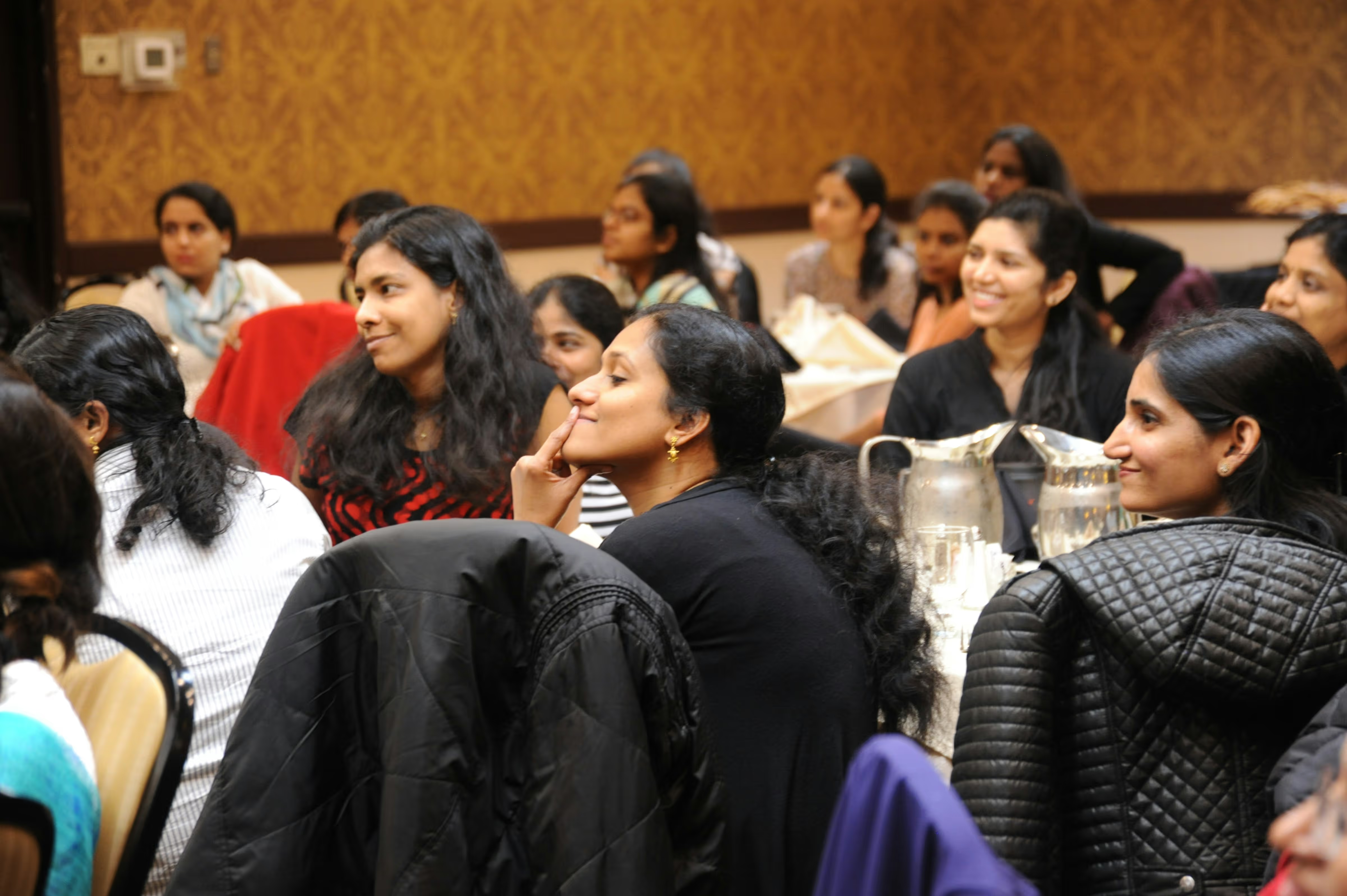
Board-Focused Curriculum
Practical perspectives and tools for engaging effectively on social purpose organisation boards.
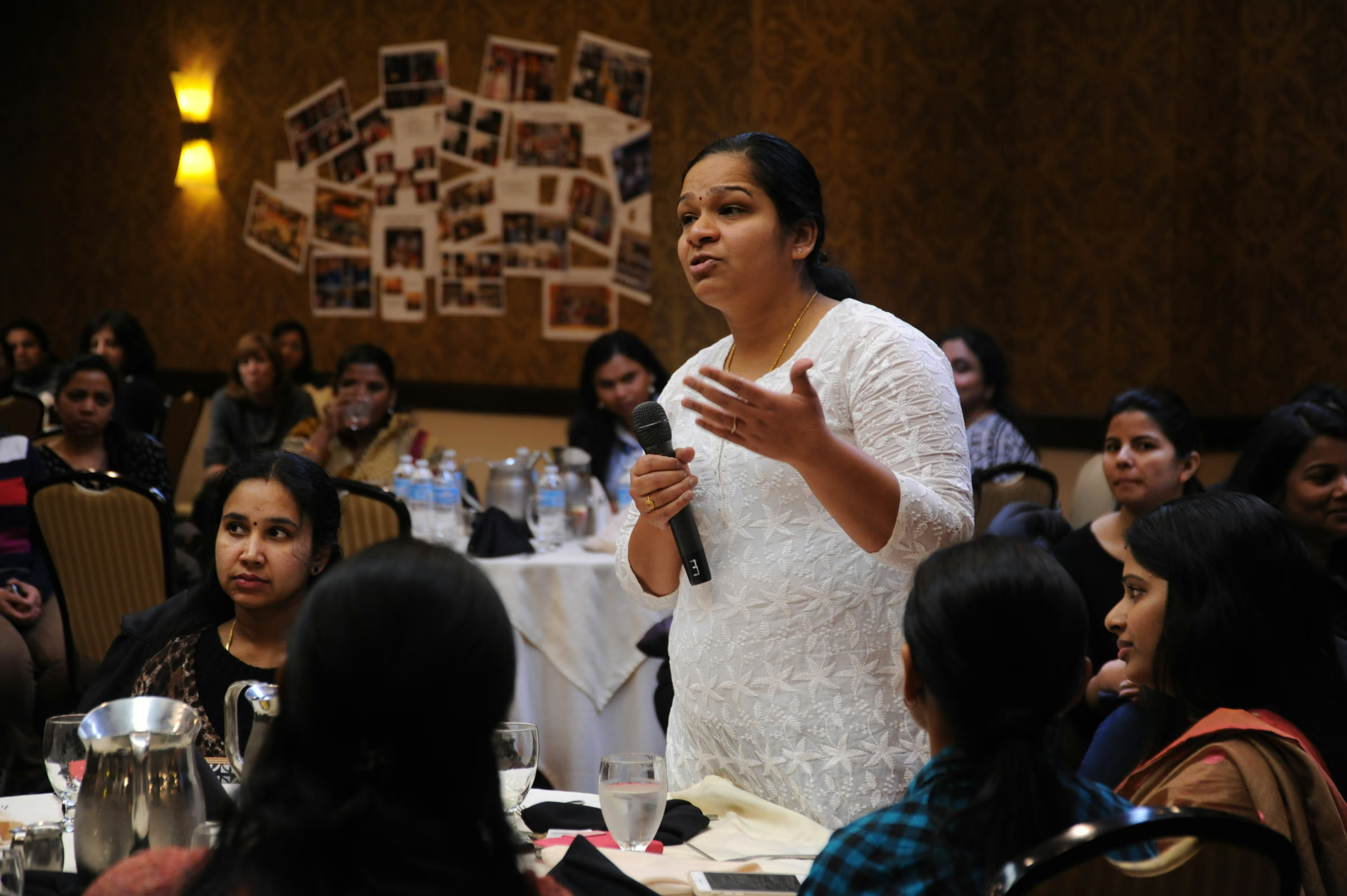
Peer And Practice-Based Learning
Case discussions, group work, and real scenarios drawn from organisational contexts.

Practitioner-Led Sessions
Interactive sessions with senior leaders and sector practitioners.

Reflection And Self Work
Guided reflection to clarify motivation, role and board-level contribution.
Who Should Apply
This program is designed for experienced women leaders seeking structured pathways into board roles.
What You Will Gain
By the end of the program, you are prepared for responsible, strategic board engagement.
Women United By Experience And Purpose
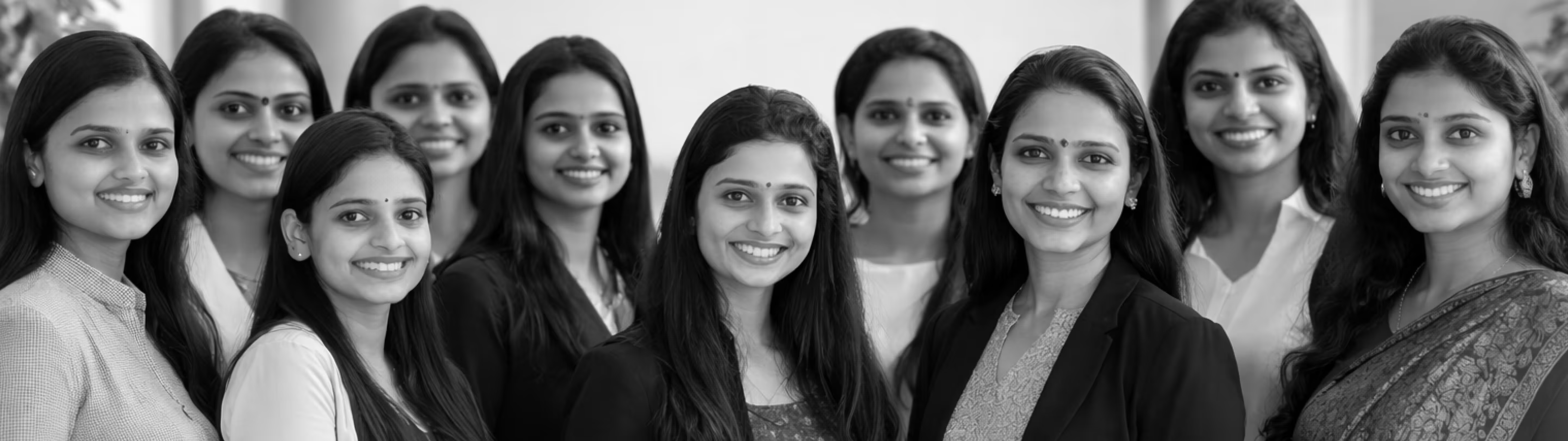
Each Women On Boards cohort brings together women leaders from diverse fields—including corporate leadership, entrepreneurship, academia and public policy.
What unites them is a shared commitment to apply their expertise to governance for social development. The diversity strengthens peer learning and reflects the boards the program seeks to build.
Companies Represented











Faculty And Network Partners

Aarti Madhusudan is the founder of Governance Counts, an initiative that helps nonprofits build more effective and accountable boards. Her work focuses on identifying governance challenges within nonprofit organisations and recommending best practices to strengthen board leadership and decision-making. She has consulted with several Indian and international organisations on governance and board development.
She is deeply passionate about volunteering and leads Whiteboard, an iVolunteer initiative that brings together senior corporate professionals to provide strategic guidance to nonprofits on a pro bono basis. Aarti also actively volunteers with DaanUtsav. She conducts the Volunteer Management Workshop.

Popularly known as the “Clothing Man,” Anshu Gupta is the recipient of the 2015 Ramon Magsaysay Award, often referred to as the Nobel Prize of Asia. After leaving a corporate career in 1999, he founded Goonj, the world’s first organization to address clothing as a development issue. Over the past two decades, he has transformed India’s culture of giving by channeling unused clothing and urban surplus materials into community-led rural development initiatives.
Through Goonj, Anshu has creatively linked the challenge of growing urban waste with the needs and priorities of marginalized rural communities, enabling large-scale, dignity-driven development work. He is a frequent speaker at global and national forums including TED and the World Economic Forum, and serves as an advisor and board member to several social enterprises and nonprofit organizations. He has also launched Gram Swabhimaan, an initiative aimed at fostering dignity, self-worth, and self-reliance among rural communities.

Biraj is a leading human rights activist and development leader, currently serving as the Executive Director of the National Foundation for India (NFI), one of India’s oldest independent domestic philanthropies. Prior to this, he was the South Asia Director at Amnesty International. He has played a pivotal role in advancing rights-based approaches in India, including serving as Principal Adviser to the Supreme Court Commissioners in the landmark Right to Food case, overseeing the implementation of major food and employment schemes.
Biraj has been closely involved in shaping key legislations such as the National Food Security Act, impacting over 900 million people. He also co-founded the Mitanin community health worker program in Chhattisgarh, which led to the nationwide ASHA initiative. He serves on multiple boards, including as Founder-Chairperson of the State Health Resource Centre, and Trustee of the Counter Media Trust.
Education: Post-graduate degree, Institute of Rural Management, Anand (IRMA); Chevening Gurukul Scholar, London School of Economics; IVLP Fellow, US State Department.

Divya is a seasoned technology and innovation leader with over 22 years of experience driving digital transformation and business growth. As Executive Director at EY GDS, she leads a team of 800+ professionals, focusing on architecting cutting-edge solutions and building impactful technology platforms, including EY’s Digital Transformation Platform. She has led over 40 client engagements, enabling transformations worth more than $500 million, and has established Centers of Excellence that deliver significant value to client operations.
Her expertise spans innovation strategy, product development, and scaling technology-driven solutions, particularly in the insurance domain. Known for taking ideas from concept to execution, Divya combines strategic vision with execution excellence to drive measurable outcomes and enhance customer experiences in complex business environments.
Education - MCA, ICFAI University; BCA, Jyoti Nivas College; SSLC, Carmel Convent.

Gaurav is a management consultant with extensive experience across both the private sector and the development space. He has worked with organisations such as P&G, American Express, Azim Premji Foundation, and Lok Capital, bringing insights from both for-profit and nonprofit contexts. His work spans sectors including microfinance, health, impact investment, and education.
With more than a decade of experience across the three major segments of education—pre-school, K–12, and higher education—Gaurav works to bridge the gap between private enterprise and development initiatives. His work focuses on leveraging strategic thinking and sector knowledge to drive meaningful improvements in the education landscape.
Education: Masters in Business Administration, Indian Institute of Management, Calcutta, B.E., Computer Science and M.Sc., Economics, Birla Institute of Technology and Science, Pilani

Kuldeep is the Co-Founder and CEO of Reap Benefit, where he has been instrumental in building a movement around public problem-solving among adolescents and youth. His work focuses on strengthening citizen problem-solving skills and improving local governance through innovative approaches to environmental education and civic engagement. Inspired by his father’s commitment to Bangalore’s environmental issues and further influenced by his experience with Jagriti Yatra, Kuldeep has dedicated his career to solving civic and environmental challenges.
A strong ethical leader, Kuldeep has received several recognitions including Ashoka’s Lead Changemaker, MIT’s Global Startup Weekend, Changelooms Fellowship, S3IDF Fellowship, StartingBloc Fellowship, and Architects of the Future. Under his leadership, Reap Benefit has pioneered initiatives that empower young people to take action on real-world problems and drive community-led change.
Education: Bachelor’s degree, Christ University, Bangalore.

Mana is a social entrepreneur and athlete who has transformed her personal journey into a powerful movement for change. From being the first college graduate in her village in Madhya Pradesh to becoming an international-level gold medallist in karate and representing India at the Asian Championships, she has earned recognition as an “iron-girl” in her community. Driven by her belief in the transformative power of sports, she provides free karate and self-defense training to girls in rural areas while nurturing peer leaders who deliver life skills and sports-for-development programs.
Through her organisation, Tinka Samajik Sanstha, Mana has impacted over 76,000 youth and children, helping break gender barriers and shift societal mindsets around girls and sports. Her work has been recognised through awards such as the Sandvik India Gender Award (2019), Martha Farrell Award Finalist (2022), and Nari Shakti Samman (2023).
Education: Master’s degree in Political Science, Government College Timarni.

Praveen Singh is the CEO of Apnalaya, an NGO that works with urban poor in Mumbai. He is a sector practitioner with over 22 years of experience in child rights, education, and local governance. He has previously been associated with organisations such as Magic Bus, Techno Serve, Arpan and CRY and brings a wealth of leadership experience and passion for creating positive impact at scale.
Praveen has also worked as a consultant with the Commissionerate of rural development in Gujarat and advocated with state governments for a successful campaign against child labour. He is also a visiting faculty at some of the leading management institutions. Praveen is a board member in Medha, an NGO working on employability.
Education: Post-graduation Diploma in Rural Management (PGDRM) from Institute of Rural management, Anand.

Ravi transitioned to the social sector in 2011 after a distinguished 24-year career in the corporate world. During his time at HSBC, he worked across more than 30 countries and held several senior leadership roles, including Regional Marketing Head for the Middle East and Africa, Head of Consumer Products for Asia Pacific, Consumer Banking Head for Indonesia, and CEO and President Director of Bank Ekonomi, which was later acquired by HSBC.
After moving to the development sector, Ravi joined the Azim Premji Foundation as Head of Education Leadership & Management, where he focused on strengthening leadership capacities within the education system. His work reflects a strong commitment to improving educational institutions and leadership practices in the social sector.
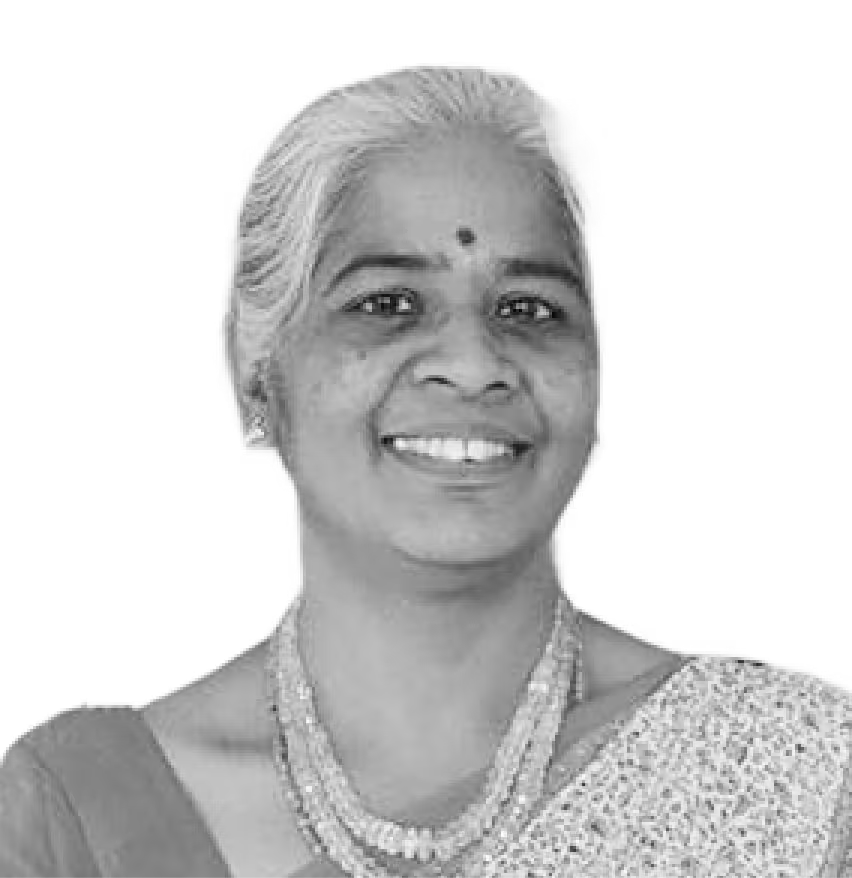
Shanthi is a results-oriented leader with over two decades of experience spanning finance, operations, compliance, and social impact. She transitioned to the development sector over a decade ago and founded ExempServ, a professional services organisation that supports boards, trustees, and leadership teams of social sector organisations with financial reporting, compliance, and allied services to enhance their effectiveness and impact. She also volunteers with v-shesh, works towards mainstreaming persons with disabilities, and serves as Treasurer of SOS India.
Prior to her work in the social sector, Shanthi built an extensive career in the outsourcing and shared services industry with organisations such as eFunds, Global Vantedge, Hewitt, and Mercer. Her experience spans HR administration, payroll, accounting, receivables management, consulting, and investments. She has also served as CSR Leader for Mercer India and as a global steering member representing Asia. Known for her execution focus, collaborative approach, and strong financial and compliance expertise, she brings a solution-oriented mindset to every role she undertakes.
Education: ACWAI, Institute of Cost and Work Accountants of India; B.Com (Hons), University of Delhi.

Sonal is the Founder and CEO of Protsahan India Foundation and an Ashoka Fellow, dedicated to strengthening care and protection systems for adolescent girls facing extreme poverty, migration, and intergenerational abuse. Her work focuses on building the capacities of frontline caregivers to ensure that vulnerable girls can access education, psychosocial care, and grow up within safe family environments.
Since founding Protsahan in 2010 with 43 girls, she has scaled its impact to reach over 96,000 Dalit, Bahujan, Adivasi, and historically marginalised girls across high-risk urban communities. Under her leadership, Protsahan has emerged as a trusted grassroots organisation and trauma-informed care partner, with initiatives like CareVerse training frontline social workers across India to strengthen child protection systems at the last mile.
Education: Post Graduate Diploma in Child Rights Law, National Law School of India University; Goldman Sachs 10,000 Women Entrepreneur Program, Indian School of Business; Bachelor’s degree in Microbiology, University of Delhi.

Sudarshan is a seasoned development leader with nearly four decades of experience across the civil society, corporate, and academic sectors. Currently serving as Chief Development Officer at Reliance Foundation, he previously led Save the Children as CEO. He is widely recognised for his expertise in participatory approaches that empower communities to drive their own development and transformation.
Over the years, Sudarshan has played a key role in major initiatives including advocacy for cooperative law reforms and the Producer Company Act, revitalising dairy cooperatives in Andhra Pradesh, launching large-scale biodiesel cultivation efforts, and leading ‘bij’—one of India’s largest rural transformation programs. He also brings academic experience, having taught at institutions such as IRMA and IIHMR, and continues to contribute to governance platforms and advisory boards in the development sector.
Education: Alumnus, St. Stephen’s College, University of Delhi; Institute of Development Studies (IDS), Sussex, UK.

Sunanda is an accomplished leader in social responsibility, impact strategy, and fundraising, with extensive experience across India and international contexts. A strong advocate of feminist philanthropy, she champions the role of women as catalysts for societal change, with a focus on advancing their socio-emotional and physical well-being.
A social entrepreneur since 2012, Sunanda is deeply committed to grassroots interventions and believes that sustainable change begins with empowering communities from within. She currently serves as the CEO of the Omega Forum for Social Impact (OFSI), where she leads initiatives aimed at driving systemic and transformative social impact.
Education: Graduate, Centre for Social Impact Strategy (CSIS), University of Pennsylvania.

Naghma has approximately 25 years of experience of working and consulting with Social Purpose Organisations and teaching at reputed institutions. Currently, she is part of the founding team and board of Rubaroo, Hyderabad, Trustee of Had Anhad, Indore, and Director, Social Synergy Foundation, Mumbai. The first two organisations work with adolescents and young people to empower them to be active citizens, whereas the Social Synergy Foundation works with small and medium-sized non-profits in India.
Her field experience has strengthened her teaching both graduate and post graduate students in the Delhi School of Social Work, School of Planning & Architecture, Ambedkar University and University of Pittsburgh. Her forte is designing and facilitating learning experiences. Through her work with Pravah, she has mentored many young people and youth-led organisations across nations.
From Readiness To Board Leadership
As part of the program, participants engage with social purpose organisations through structured advisory exposure.
75% of Women On Boards participants have been placed on advisory boards across the social impact sector.







.avif)




.avif)
Enrolments Open For New Cohort
Lead where it matters most
Frequently Asked Questions
The primary goal of the Women on Boards program is to provide a platform that enables the transfer of learnings, thoughts and ideas, between the corporate and social impact sectors. It encourages more women to serve on nonprofit boards while bringing diverse skills, experiences, and perspectives to these organisations.
The program will aim to ensure active learning across sessions, via:
- Case studies
- Role play
- Expert-led sessions
- Exercises, activities and group work
- Self-reflective work
- Peer learning
- Mentorship
- Sector Immersion
The program is structured to include classroom engagement, one day of on-field immersions with organisations, self-reflective and a deep dive into case studies, and mandatory pre-reads before the modules. Hence you would be required to dedicate:
- 60 hours of classroom learning
- 20 hours of volunteering with partner organisations between modules
- 20 hours for self-reflection, case studies, and pre-reading
As a participant, you will receive insights into the Indian social sector. In addition, you will find opportunities to serve on Advisory Boards of social impact organisations. The experience during and after this program will help build your institutional governance experience overall.
No. Attendance for every engagement is mandatory in order to complete the program and receive certification.
No, as a board member you won’t be entitled to any salary or honorarium.
Currently, we aren’t providing any financial assistance.
It would depend on the organisation’s needs and the expectations set in the beginning. However, it would be a considerable amount of time for the organisation to benefit from your expertise.
Here are the guidelines for making connections to SPOs:
- Participants who complete all modules and sessions will be given preference in recommendations to the organisations for advisory positions.
- The participants who miss out on sessions will need to complete the same through listening in to recordings, allotting time for discussions with faculty/peers to be considered for advisory positions.
.avif)