
Measuring Impact: From Reporting to Learning
What would it take to make measurement useful beyond reporting? A conversation on shifting from compliance-driven data collection to learning that informs decisions, adaptation, and long-term impact.
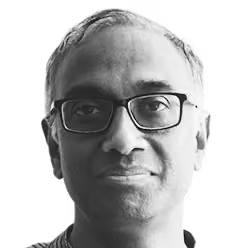
Narendranath Damodaran has had a distinguished career with PRADAN (Professional Assistance for Development Action), spanning over three decades from 1989 to 2024. His contributions to the organization have been significant, particularly in integrating the self-help group (SHG) program across multiple states in India. His work involved a range of responsibilities, including developing program strategies, building perspectives for project leaders, training staff, and designing and planning the implementation of programs.
Naren's expertise was not limited to the technical aspects of program implementation; he also played a key role in setting up monitoring systems, supporting field teams, and raising funds for various initiatives. Along with serving in key management positions of PRADAN, including the Management Unit and the Governing Board, he led the embedded cell with the National Rural Livelihoods Mission (NRLM). Naren served as the Executive Director of PRADAN from April 2017 to March 2022, a role in which he had a significant impact on the direction and growth of the organization. Currently, he works as an independent consultant, providing strategic guidance and technical support to various development consortiums and organizations, and also serves as the National Anchor for the National Coalition on Natural Farming.
Naren holds a degree in mechanical engineering from Kerala University and a Postgraduate Diploma in Rural Management (PGDRM) from the Institute of Rural Management Anand (IRMA).

Suneeta Krishnan oversees strategy, financial planning, business operations, and measurement, learning, and evaluation for the foundation’s India Country Office. In this role, she supports teams within the office in using data and evidence to refine their strategies and program implementation and advance gender and diversity, equity, and inclusion goals. She also manages grantmaking to enhance research and evaluation capacities in India.
Before joining the foundation, Suneeta served as the India country director of Research Triangle Institute International India, a subsidiary of a U.S.-based nonprofit that provides research, development, and technical services to government and commercial clients. Her work there focused on ongoing and emerging development challenges related to health, the environment, and energy in India.
Earlier, Suneeta served on the faculty at the University of California, San Francisco, where she conducted research and taught courses on structural inequalities and women’s health. She has also held adjunct positions at the University of California, Berkeley; St. John’s Research Institute, Bangalore; and James P Grant School of Public Health, Dhaka.
Suneeta has an undergraduate degree from Barnard College and a doctorate in epidemiology and biostatistics from UC Berkeley. She received the U.S. Presidential Early Career Award for Scientists and Engineers in 2004 and was featured in Time magazine.
Episode Overview
Impact measurement help organisations demonstrate accountability, communicate results, and show evidence of change. But over time, measurement has increasingly focused on what can be counted, reported, and standardised. The insights generated often fail to influence how programmes are designed, implemented, or improved.
This session explores a different approach to measurement, one that moves beyond compliance and asks a more practical question: how can measurement become a tool for learning? It examines what it takes to embed measurement into implementation from the start, how organisations can use evidence to adapt and improve, and how funders can create accountability systems that support learning rather than add burden.
Episode Highlights:
- Why measurement systems are often designed for reporting rather than learning — and what that means for organisations on the ground
- What it takes to integrate measurement into implementation and decision-making from the outset
- How funders can rethink reporting and accountability to better support learning and adaptation
- Where organisations and funders need to work differently — and where they need to work together
WATCH RECORDING
Recording Will be uploaded Soon!
.avif)